Morse Code Alphabet
Look up A–Z, 0–9, and common punctuation in dots and dashes.
International Morse code represents characters as groups of short signals (dots) and long signals (dashes). Use the tables to look up a character, or use the morse code translator to convert a message and hear its rhythm.
Working with zeros and ones instead? Use the binary code translator for UTF-8 text and bytes.
Try text in Morse code
Enter letters, numbers, or supported punctuation to see their Morse code. Spaces separate letters; / separates words. Your text stays in this tab and is not saved.
Enter text to convert it to Morse code.
Morse Code Alphabet (A–Z)
Use Play beside a letter to hear its short and long tones. In typed Morse, keep each letter’s marks together and use a space between letters. For example, .- -... reads AB.
| Character | Morse | Audio |
|---|---|---|
| A | .- | |
| B | -... | |
| C | -.-. | |
| D | -.. | |
| E | . | |
| F | ..-. | |
| G | --. | |
| H | .... | |
| I | .. | |
| J | .--- | |
| K | -.- | |
| L | .-.. | |
| M | -- |
| Character | Morse | Audio |
|---|---|---|
| N | -. | |
| O | --- | |
| P | .--. | |
| Q | --.- | |
| R | .-. | |
| S | ... | |
| T | - | |
| U | ..- | |
| V | ...- | |
| W | .-- | |
| X | -..- | |
| Y | -.-- | |
| Z | --.. |
Morse Code Numbers (0–9)
Each digit uses five signals. Try comparing 1 (.----) with 6 (-....), then follow the pattern down the chart.
| Character | Morse |
|---|---|
| 0 | ----- |
| 1 | .---- |
| 2 | ..--- |
| 3 | ...-- |
| 4 | ....- |
| Character | Morse |
|---|---|
| 5 | ..... |
| 6 | -.... |
| 7 | --... |
| 8 | ---.. |
| 9 | ----. |
Morse Code Punctuation and Symbols
These are the 18 punctuation marks that Txtopia accepts. For radio procedures, timing, and the standard repertoire, see ITU-R M.1677, International Morse code.
| Character | Morse |
|---|---|
| . | .-.-.- |
| , | --..-- |
| ? | ..--.. |
| ' | .----. |
| ! | -.-.-- |
| / | -..-. |
| ( | -.--. |
| ) | -.--.- |
| & | .-... |
| Character | Morse |
|---|---|
| : | ---... |
| ; | -.-.-. |
| = | -...- |
| + | .-.-. |
| - | -....- |
| _ | ..--.- |
| " | .-..-. |
| $ | ...-..- |
| @ | .--.-. |
Use the chart to read, write, or check a message
Read a clue one group at a time
Suppose a game gives you .-.. . ..-. - beside a drawing of two arrows. Start with the first space and look up only .-... Write down L, then look up the next group to get E. The last two groups give F and T. Now compare LEFT with the drawing. Keeping the lookup and the interpretation separate helps you catch a mistaken dot before the picture biases your reading.
A clue copied from a screenshot can lose its spacing. Keep the original image and check whether it contains gaps you missed. If the dots and dashes really run together, use the decoder for missing letter spaces to compare possible splits. A sketch of the source can preserve useful details that a flat copy leaves out, such as a wider gap or a separate row.
Write initials or a short note
Start with a small sample such as HI. Find H and I in the table. Copy the whole pattern for H, add a space, and copy the pattern for I to get .... ... For HI THERE, place a slash between the words so the wider break survives in a chat or printed note. Then hand the code to someone who has not seen the original. If they read the same text without asking where a letter ends, your spacing works.
The slash used as a word break differs from the slash as a character. For a date written as 1/2, write the digit 1, the encoded slash -..-., and the digit 2 as three separated character groups. A literal slash between groups tells the reader to start a new word. The numbers and punctuation tables let you verify those cases without guessing from the letter patterns.
Check audio or a design before sharing it
For a listening exercise, play the letter you are unsure about. Compare two letters that differ in just one place, such as R and W. Both start with a short tone and a long tone. R ends short and W ends long. If you are checking a beaded bracelet, printed clue, or dot-and-dash design, have another person read it in the intended direction. Ask them to say where each group ends before showing them the text.
When listening to a longer recording, pause after a group you can hear clearly and compare it with one row of the chart. A dash lasts three dot units. In standard timing the gaps are one unit within a letter, three between letters, and seven between words. Those relative lengths are more useful than a fixed time in seconds. The SOS audio example lets you hear the continuous distress pattern and compare it with the written letters S, O, and S.
How to memorize the letters by sound
Learn a few rhythms and compare them
Start with E and T, the one-signal letters. Play E once, say its name, then play T. Close the chart or look away and try to recall which was short. Next compare I and M, which use two copies of the same signal. Observe the pause between the two sounds. Once you can identify those four, add A and N. They use one dot and one dash in opposite orders, so concentrate on which sound comes first.
Use sound for recall and the printed pattern for checking. Saying “short long” once can help you get started, but practice until A comes to mind as soon as that rhythm ends. To check whether you recognize the letter independently of its neighbors, alternate A and N, then switch to an unpredictable order. If you can only name A when it follows N, keep those letters in the practice set for another round.
Practice the letters you mix up
Keep a short list of confusions. S and H sound similar because both use only dots. Play each a few times and listen for the extra pulse in H. D and U both have three marks, but D begins with the long tone and U ends with it. If you heard U when the answer was D, pay attention to the start of the next playback and retest that pair after a short break. This gives you a specific listening task instead of another trip through all 26 letters.
Recall before you reveal the answer
Write TEAM from memory, check the sequence - . .- --, then play the four letters from the chart. On another round, have a partner choose a letter and play its row while you look away. Answer before checking the screen. If you are practicing alone, practice with Koch listening lessons for prompts without the answer visible. The lessons begin with K and M and add one letter at a time.
End a practice round by writing down which rhythms you confused and trying them again the next day. If you can identify individual letters but miss them in a word, practice short words with well-spaced letters. First listen for the group boundaries, then name each letter. Use the chart to check the specific places where you lost the rhythm.
Keep word spacing when you practice a message
Take the message GO ON. Write G and O as --. ---, add the slash, and then write O and N as --- -.. Read the complete line back as two groups of letters. Cover the words and ask yourself whether you can recover where the first O ends and the second one starts. If you erase every separator, the marks stay in order but the reader has to reconstruct both kinds of break. This makes a useful check when you are transferring a message from a notebook into a chat or onto a narrow label.
To hear the difference, enter GO ON in the translator and play the whole result. Compare the short pause inside G with the longer pause before the first O and the longest pause between the words. Next play G by itself from the table. The letter sounds the same, while the full message gives you the context that shows where to stop writing one letter and start the next.
Use the digit pattern as a separate exercise
Practice numbers after the shorter letter rhythms feel familiar. Digits 1 through 5 build from one leading dot to five dots. Then 6 through 0 build from one leading dash to five dashes. Compare 2 with 7 to hear how two short beats at the start turn into two long beats. If you are copying a number, use the five-mark length as a check and compare adjacent rows when the sequence looks off.
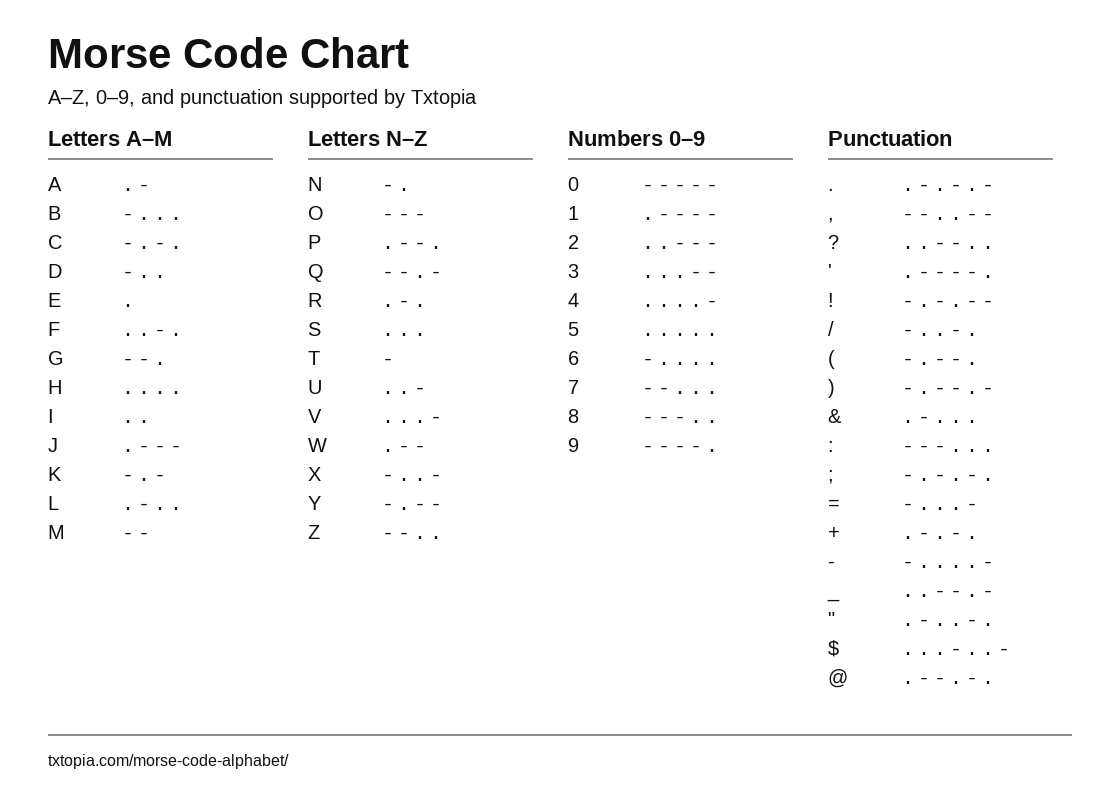
Morse Code Chart (Printable)
Open the chart and choose landscape orientation in your print dialog. A paper copy works well for partner practice. One person reads a short message aloud in dots and dashes while the other marks the groups they hear. Check each missed letter against the chart and repeat just that group.
FAQ
What is the Morse code alphabet?
It maps each letter from A to Z to a group of dots and dashes. A is .-, B is -..., and C is -.-.
How do I read Morse code without losing my place?
Read one group at a time. In written Morse, put a space between letters and use a slash between words. For example, .... .. / - .... . .-. . reads HI THERE.
Why do Morse code numbers all have five signals?
The digit patterns follow a cycle. From 1 through 5, add one leading dot at a time. From 6 through 0, add one leading dash at a time.
How do I write an actual slash in Morse code?
A slash character is encoded as -..-. In typed Morse, a literal / between groups acts as a word separator in Txtopia.